
Procurement Operations Outsourcing: What It Covers and When It Fits
The unglamorous half of procurement is where the leaks live
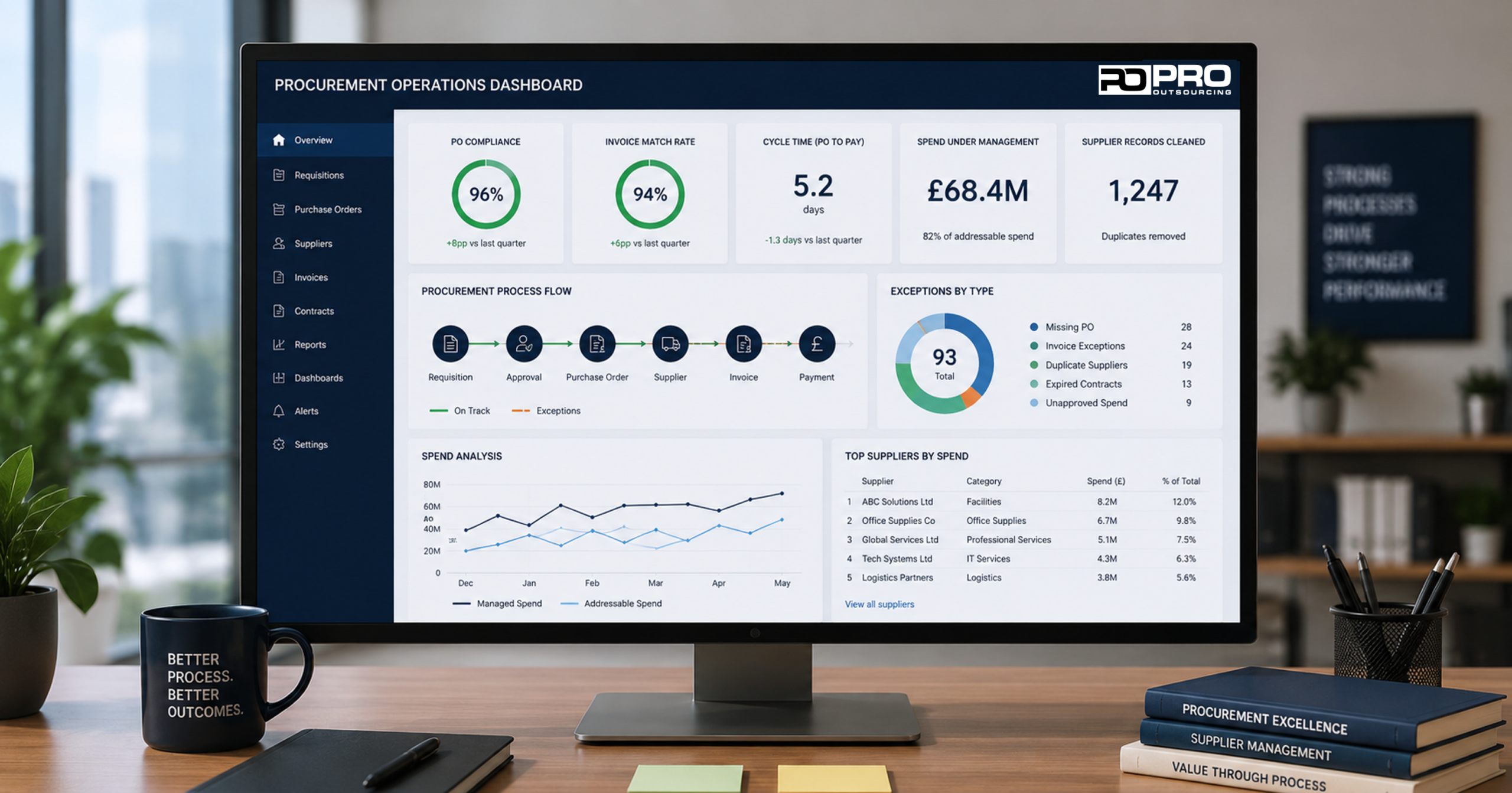
When people talk about procurement, they usually mean the strategic end. Category strategy, big tenders, supplier negotiations, the deals that move the P&L in one go. That work matters, but it is not where most mid-market businesses actually struggle. The struggle is in the daily grind underneath. Requisitions sitting in inboxes, POs raised after the invoice arrives, suppliers chasing for missing master data, contracts living in a shared drive nobody trusts.
That layer is procurement operations, and outsourcing it is now one of the most common entry points into a managed service relationship. It is not the most exciting topic in the room, which is partly why it gets neglected, and partly why the returns are quietly very good.
A working definition
Procurement operations outsourcing is the delegation of the transactional and administrative layers of the procurement function to an external provider. It covers the day-to-day mechanics of buying, paying and managing suppliers, rather than the strategic decisions about what to buy and from whom. It is a sub-set of procurement outsourcing more broadly, and it is the layer most businesses outsource first.
The work is unglamorous but it is high volume, repeatable and measurable. Those three characteristics are exactly what makes it well suited to a managed service. The provider runs the process, you keep the decision rights.
How this differs from strategic procurement outsourcing
It is worth being precise about the boundary. Strategic procurement outsourcing involves category management, sourcing strategy, negotiation leadership, supplier segmentation and the harder commercial work. It is judgement-heavy and lower volume.
Procurement operations outsourcing is the opposite shape. Higher volume, more process-driven, less judgement per transaction, and usually delivered through a mix of people, workflow and increasingly some automation in the requisition and PO layers. The two services can sit side by side, but they are not interchangeable and pricing them as if they were is a common mistake.
What is typically in scope
Across the engagements I see, the scope of an operations service tends to settle around a fairly stable list. The detail varies by sector but the shape does not.
| Typical activities in scope | Typically out of scope |
| Requisition handling and approval routing | Category strategy and market analysis |
| Purchase order creation, scheduling, dispatch and tracking | Major tender leadership and contract negotiation |
| Supplier onboarding, due diligence and master data | Final supplier selection on strategic categories |
| Contract administration, renewals tracking, document control | Board-level supplier relationship ownership |
| Vendor management, performance reporting, SLA monitoring | Make or buy decisions |
| Invoice matching support and P2P exception handling | Capital expenditure approval |
| Spend reporting, dashboarding and basic analytics | Procurement policy authorship and sign-off |
| Helpdesk for internal users raising procurement queries | Mergers, acquisitions and integration strategy |
The principle is simple. Anything that is rules-based, repeatable and can be measured against an SLA tends to be in scope. Anything that requires commercial judgement, brand-level relationships or strategic trade-offs tends to stay with you.
Who this is actually for
The buyer is usually an operations director or FD in a business with £20m to £200m turnover, with addressable third-party spend of £5m or above. The trigger is almost always a specific failure mode rather than strategic ambition.
Finance is tired of chasing missing POs and reconciling invoices to nothing. Operations is tired of suppliers calling because their bank details have not been updated for six months. The MD has noticed the same vendor appears three times in the ledger under slightly different names. None of those are strategic problems. They are operations problems, and a category manager will not fix them.
The other common trigger is an ERP implementation or migration. The new system is in, the workflow is theoretically clean, but nobody internally has the bandwidth to run the operational discipline that the system assumes. An outsourced operations team plugs straight into the workflow without needing recruitment.
The commercial case
The economics on this layer are clearer than most people expect. Transactional procurement is high-volume work, much of it duplicated across businesses, and a provider running it at scale will typically deliver 15 to 25 percent efficiency on the transactional load compared to running the equivalent function in-house. Some of that comes from headcount substitution, but more of it comes from cycle time, error rates and the cost of rework.
On top of that, there is usually a hard saving from better master data and contract discipline. Duplicate supplier records get cleaned, off-contract spend gets pulled back, missed rebates get claimed. Together those typically recover one to two percent of total spend in the first year.
The number that matters to the FD is not the saving itself, it is the saving net of fees. On a £10m spend base, a fee in the £150k to £250k range against £500k of recovered value is the rough shape of a credible engagement. Anything that promises much more than that on the operations layer alone is probably overpromising, and it is fair to ask hard questions about how the numbers are built.
Sizing guidance
As a rough sizing rule, the operations layer becomes a credible candidate for outsourcing once you have around two full-time equivalents of internal transactional procurement work, or addressable third-party spend above £5m. Below that, a fractional resource or a tighter use of the existing finance team is usually a better answer. Above it, the volume tends to justify a dedicated procurement outsourcing services arrangement, scaled to your transaction count rather than your headcount.
One last point. Operations outsourcing is not a stepping stone you have to take before anything strategic. Some businesses run it as a standalone service for years. Others layer category work on top later. Both are valid. The test is whether the operational layer is currently working, and if not, whether fixing it internally is worth the cost.
If you would like a view on whether your transactional procurement load is the right size and shape for this service, get in touch for a 30-minute conversation.
great resources:
CIPS – Leading global excellence in procurement and supply