
Consultancy vs Fractional Procurement Support: One Sells Activity, The Other Delivers Outcomes
Most procurement consultancies look good on paper. Big teams, structured methodologies, polished outputs. But strip it back and ask one question:
Did it actually deliver the outcome?
That is where the model starts to fall apart. More organisations are moving towards fractional procurement support and niche micro consultancies because they want results, not process.
The Real Difference
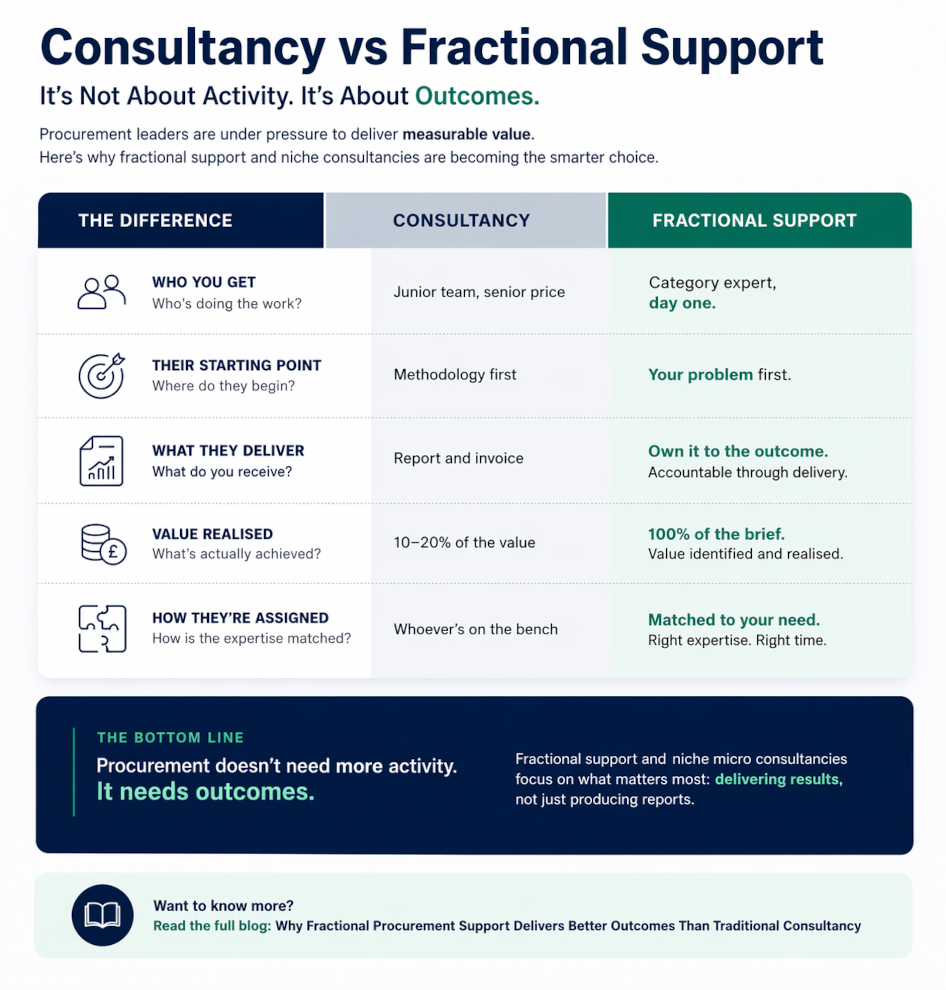
Who you get
Consultancy: You are often sold senior experience, but delivery sits with a junior team.
Fractional support: You get a hands-on expert from day one. No layers, no translation, no drop-off in quality.
Where they start
Consultancy: Methodology, frameworks, diagnostics.
Fractional support: Your problem. What is broken, what needs fixing, what will move the needle.
What gets delivered
Consultancy: Report, slide deck, invoice.
Fractional support: Ownership, delivery, outcome.
This Is The Bit That Matters
Procurement does not exist to produce documentation. It exists to reduce cost, improve supplier performance, manage risk, and drive efficiency.
So the only question that matters is:
Who is accountable for delivering the outcome?
Not activity. Not output. Outcome.
The Value Gap No One Talks About
Most consultancies identify value. Savings opportunities, efficiency gains, process improvements. Then they leave.
Internally, teams are stretched, priorities shift, delivery slows, and value leaks.
Fractional support closes that gap by staying in the delivery. Not just pointing at the opportunity, actually realising it.
Why Micro Consultancies Are Winning
There is a shift happening. Smaller, specialist firms are outperforming larger consultancies because they are built differently.
No bench to fill. No unnecessary layers. No dependency on selling more days.
They are there to solve a problem and deliver an outcome. Simple.
Assignment Model
Consultancy model: Whoever is available.
Fractional model: Who is right for the job.
It sounds obvious, but it changes everything.
Bottom Line
If you are getting a report, a set of recommendations, and an invoice, you have paid for activity.
If you are getting ownership, delivery, and measurable results, you are paying for outcomes.
If procurement is under pressure to deliver more with less, it may be time to rethink how you bring in support. Get in touch for a practical review.
If you want help spotting weak points before they become expensive problems, contact Pro Outsourcing for a no-obligation discussion.
See our other blogs
recommended further reading: