
The Day Everyone Asked for the Template
A few years ago, I spent some time teaching MCIPS, and there was one moment that cropped up on almost every course. We’d spend the morning working through Kraljic, Porter’s Five Forces or stakeholder mapping. We’d discuss why the framework existed, where it added value and how it should influence commercial decisions. Everyone was engaged and asking good questions. Then we’d break for coffee, people would open their laptops and someone would inevitably ask, “Has anyone got a template for this?”
It was never because they didn’t understand the theory. Quite the opposite. They understood it perfectly well. What they didn’t want to do was spend the next hour drawing boxes, arrows and matrices in PowerPoint before they could actually start thinking about the supplier in front of them.
That always struck me as odd because procurement isn’t supposed to be about formatting slides. The value isn’t in drawing a Kraljic Matrix. The value is in the conversation that happens once you’ve put a supplier on it.
What’s funny is that it isn’t just people studying for MCIPS who do this. I’ve walked into enough procurement teams over the years to know it happens everywhere. Someone has a board meeting tomorrow and needs a stakeholder matrix. Someone else is presenting a sourcing strategy and needs Porter’s Five Forces. Before long they’re resizing text boxes, trying to align shapes and wondering why PowerPoint has suddenly become their biggest challenge of the day.
I’ve done exactly the same thing myself more times than I care to admit.
The more I thought about it, the stranger it seemed. These frameworks have been around for decades because they work. They help us structure our thinking, challenge assumptions and explain complex commercial decisions. Yet thousands of procurement professionals are still recreating the same diagrams from scratch every time they need one.
It felt like solving the wrong problem.
Over the years I’d accumulated dozens of versions of these tools. Some I’d built for clients, some for workshops, others because I could never quite find one that looked right. They sat in folders on my laptop, getting copied from one project to the next. Eventually I asked myself a simple question. If I keep reusing these, why isn’t everyone else?
That’s really where the idea came from.
Rather than leaving them buried on my hard drive, I’ve started putting them on the website for anyone to use. They’re not behind a paywall, there’s no registration form and I’m not asking for your email address before you can download a stakeholder map. Just open the tool, use it and get on with the part that actually adds value.
Although the idea started with my time teaching MCIPS, these tools aren’t just for students. They’re just as useful if you’re preparing for a supplier workshop, presenting to your board or trying to explain a category strategy to colleagues who don’t live and breathe procurement. Sometimes a simple framework communicates an idea far better than ten pages of text ever could.
This is only the beginning. I’ll keep adding to the library as time goes on because there are plenty of practical procurement tools that deserve to be easier to access. If they save someone an hour before a presentation, brilliant. If they help someone studying for their exams, even better. And if they mean one less procurement professional spends their afternoon fighting with PowerPoint, then they’ve done exactly what I hoped they would.
Explore the Free Procurement Tools Library
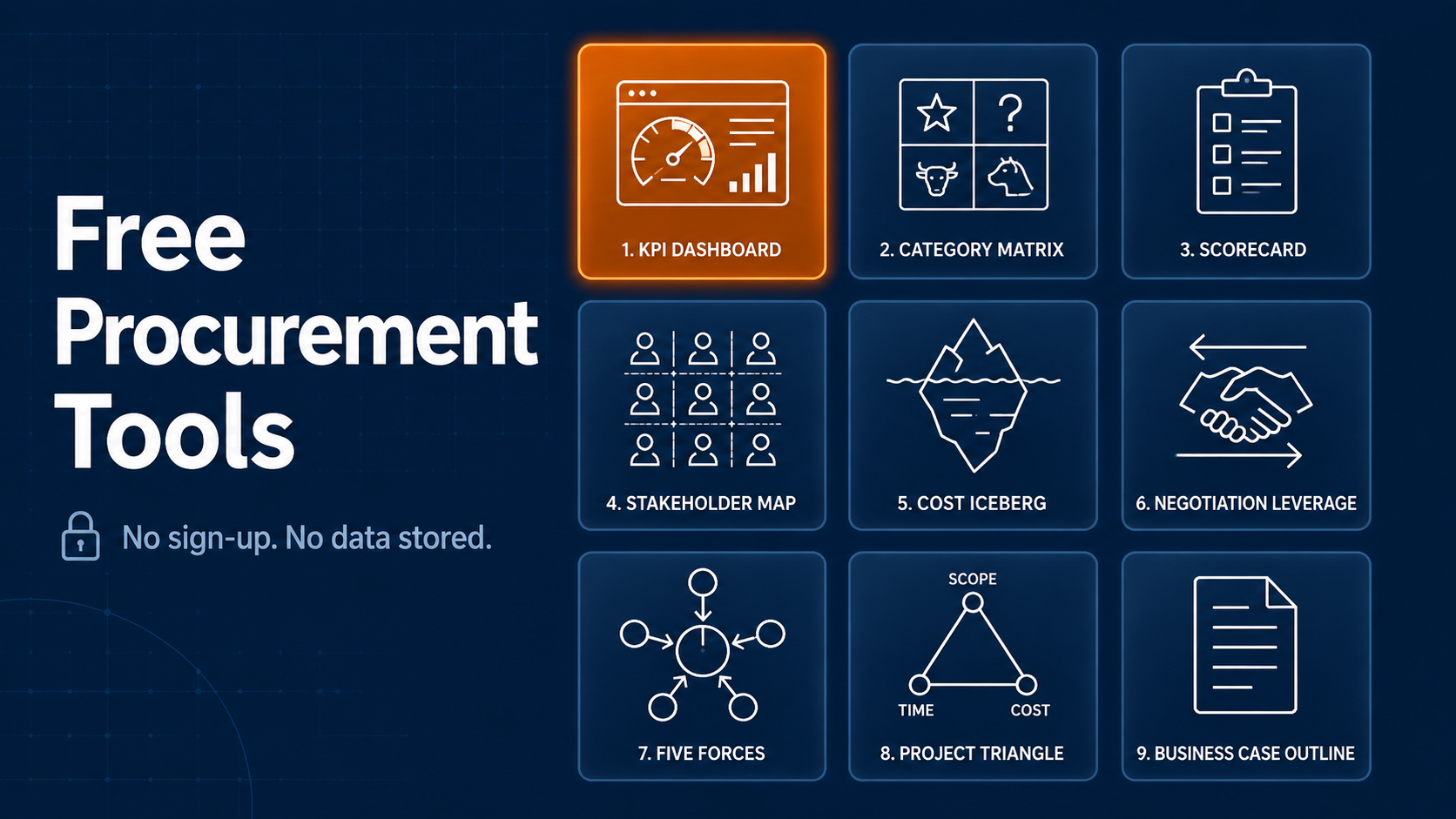
Practical tools built from real procurement delivery, including a KPI dashboard, supplier positioning matrix, TCO calculator and negotiation planner. No email gate, free to use and share with your team.
Browse the Free ToolsRuns in any browser. No sign up. No data stored.