
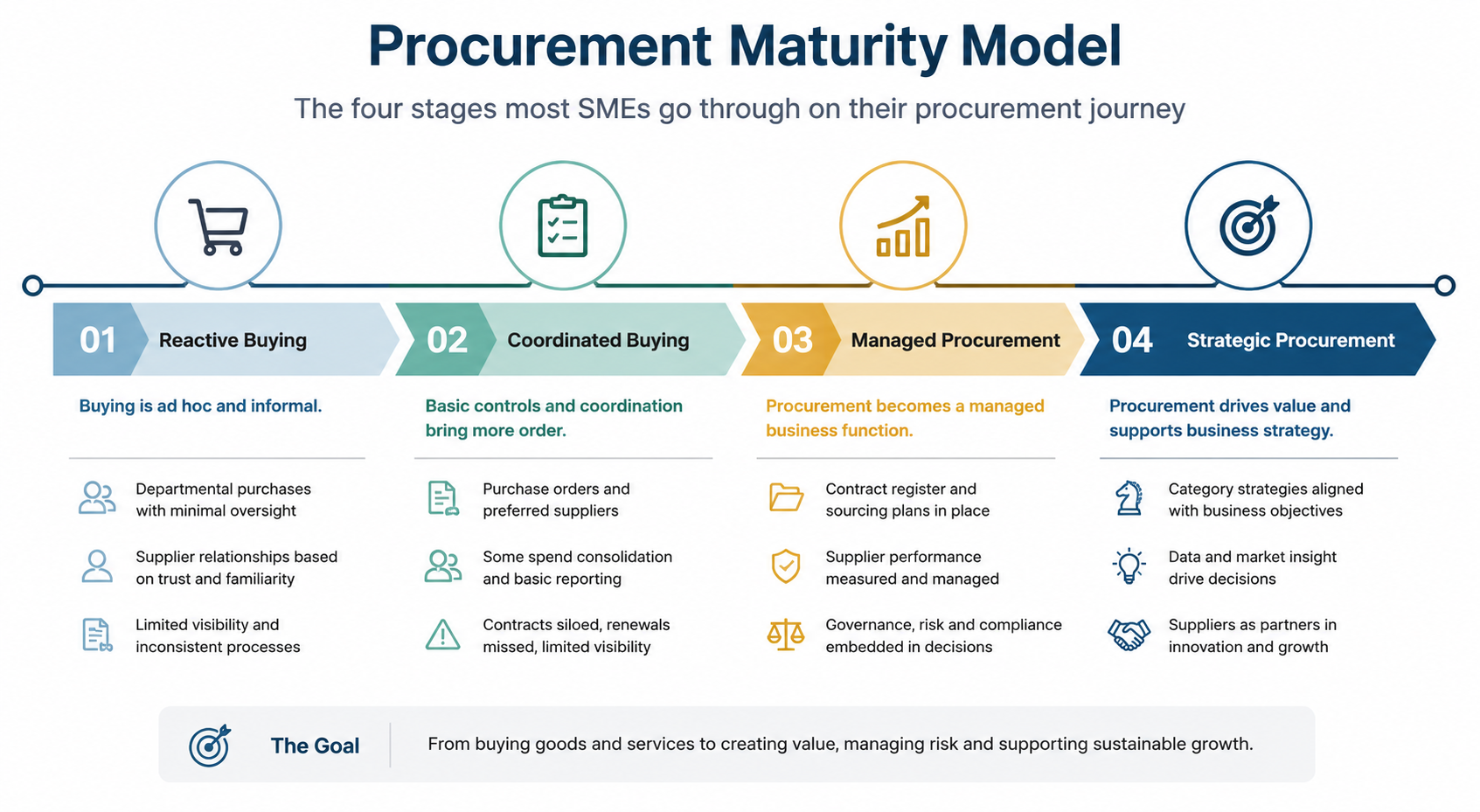
Procurement Maturity: The Four Stages Most SMEs Go Through
Most business owners don’t wake up thinking about procurement maturity.
They notice something else first.
Supplier costs keep creeping up. Contracts renew without challenge. Different departments buy the same products or services from different suppliers. Nobody is quite sure when key agreements expire.
The natural reaction is to ask whether it’s time to hire someone.
That may be the right answer. Equally, it may not.
Before deciding how to resource procurement, it helps to understand how procurement typically develops as a business grows. Most organisations move through four recognisable stages. Recognising where your business sits today makes it much easier to decide what should come next.
The four stages of procurement maturity
As organisations grow, procurement typically evolves from reactive buying into a strategic business function. Each stage brings greater control, better visibility and stronger commercial outcomes.
Stage 1. Reactive Buying
In the early days, buying is simply part of everyone’s job.
Department managers place orders, business owners approve larger purchases, and supplier relationships rely on trust and familiarity rather than structured commercial agreements.
At this stage, that approach usually works. Purchasing volumes remain relatively low, decisions are quick, and formal procurement would probably add unnecessary administration.
However, the cracks begin to appear as third party spend grows faster than the processes supporting it.
Stage 2. Coordinated Buying
This is where many SMEs find themselves.
Purchase orders have been introduced. Finance has better visibility. A buyer, office manager or finance colleague may coordinate suppliers and maintain a preferred supplier list.
Operationally, the business feels more organised.
Strategically, very little has changed.
Contracts remain scattered across inboxes and filing cabinets. Teams judge supplier performance through experience rather than data. Renewals arrive unexpectedly, and departments continue to negotiate independently.
Nothing feels obviously broken. However, valuable opportunities disappear.
Stage 3. Managed Procurement
At this point, procurement becomes a recognised business function rather than an administrative activity.
A clearly defined owner takes responsibility for supplier spend.
The business records and reviews contracts. Teams plan major sourcing activities instead of reacting to them. Procurement measures supplier performance, while governance, commercial risk and compliance become part of everyday decision making.
As a result, procurement begins contributing to business performance instead of simply processing purchasing activity.
Stage 4. Strategic Procurement
The most mature organisations integrate procurement into business planning.
Category strategies support wider commercial objectives. Market intelligence shapes sourcing decisions. Strong supplier relationships create opportunities for innovation as well as cost reduction.
Consequently, procurement moves beyond buying goods and services and becomes a competitive advantage.
Larger organisations often achieve this through a dedicated procurement function with executive representation. Smaller businesses may reach the same level by embedding procurement capability throughout the organisation.
A simple comparison
| Stage | What it typically looks like | What’s usually next |
|---|---|---|
| 1. Reactive Buying | Buying is handled by individual departments or the business owner. Supplier relationships are built on familiarity and day to day needs. | Introduce basic purchasing controls, improve visibility of spend, and establish consistent buying processes. |
| 2. Coordinated Buying | Purchase orders, preferred suppliers and basic controls are in place. Procurement is organised operationally but lacks strategic ownership. | Improve contract management, consolidate spend, introduce supplier performance measures, and strengthen governance. |
| 3. Managed Procurement | Procurement is an established business function with contract registers, sourcing plans, supplier management and clear governance. | Build category strategies, improve analytics, and align procurement more closely with business objectives. |
| 4. Strategic Procurement | Procurement is fully integrated into business strategy, using data, market intelligence and supplier collaboration to create competitive advantage. | Continuous improvement, innovation, resilience and long term value creation. |
Why Stage 2 lasts longer than it should
Stage 2 often feels comfortable.
The business has introduced enough process to solve the obvious problems, but not enough structure to unlock the next level of commercial performance.
As a result, procurement improvements continually fall behind sales, operations, recruitment and customer projects.
Over time, that creates hidden costs.
- Contracts extend without review.
- Supplier pricing drifts away from the market.
- Commercial knowledge sits with individuals instead of the business.
- Procurement data becomes fragmented.
- Risks remain hidden until they become expensive.
These issues rarely appear overnight. Instead, they build gradually over months and years.
Moving beyond Stage 2
Fortunately, there isn’t a single model that suits every organisation.
Some businesses recruit an experienced procurement leader.
Others develop existing internal capability.
Many bring in external expertise for a defined period to establish governance, strengthen supplier management and improve contract visibility before deciding on a long term structure.
The right approach depends on organisational complexity, regulatory requirements, growth plans and the importance of third party spend.
More importantly, procurement should be viewed as a capability to build rather than simply a role to recruit.
Three questions worth asking
If you’re unsure where your business sits, ask yourself three simple questions.
-
1
Could you produce a complete contract register, including renewal dates and notice periods, within an hour? -
2
Do you know which suppliers account for most of your external spend, and when you last benchmarked them? -
3
Has your business given one person clear accountability for procurement outcomes?
If you struggle to answer any of those questions, your procurement capability may have reached the point where additional structure would create significant value.
No pitch. Just a look at where you stand and what would move the needle.
Final thoughts
Procurement maturity isn’t about introducing more process for the sake of it.
Instead, it’s about ensuring the way your organisation buys evolves alongside the way your organisation grows.
Businesses that recognise when they have outgrown coordinated buying usually gain better commercial control, reduce supplier risk and build stronger long term supplier relationships.
Procurement rarely transforms a business overnight. However, it often becomes one of the quietest drivers of sustainable growth over time.
commercial risk and build stronger supplier relationships over the long term
great resources:
CIPS – Leading global excellence in procurement and supply