
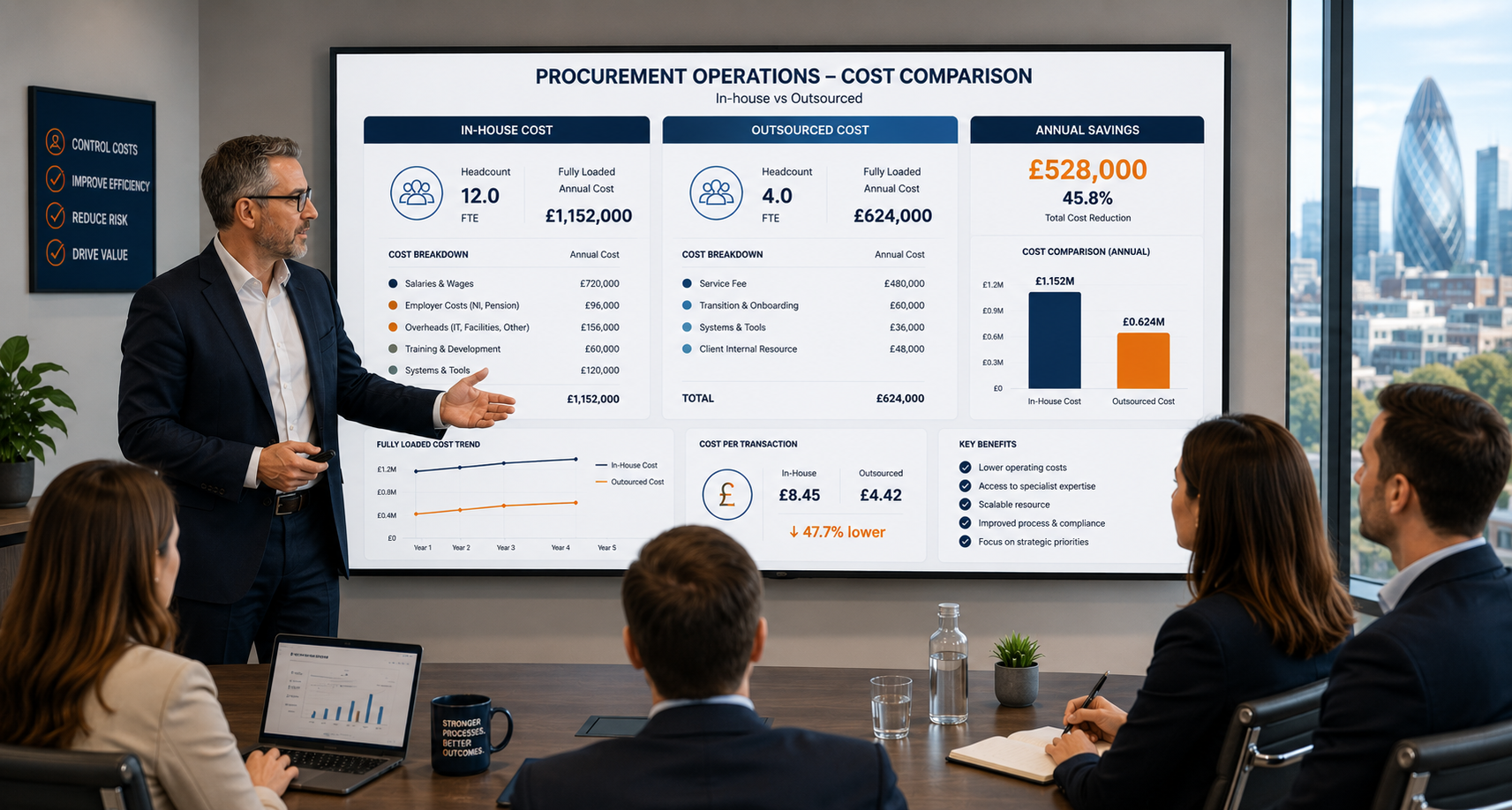
Outsourced Procurement vs In-House: The Real Cost Comparison
Most cost comparisons get this wrong before they start
Ask a finance director to compare in-house procurement with an outsourced model and you will usually get a back-of-envelope answer. Salary on one side, monthly fee on the other, and a quick judgement about which looks cheaper. The problem is that almost every line that matters has been left off the page.
A fair comparison has to include the fully loaded cost of running the function in-house, the cost of the technology stack that supports it, the productivity drag while roles are vacant, and the delivered savings net of the fee on the outsourced side. When you put all of that on one sheet, the answer changes in most mid-market businesses.
This article walks through three realistic UK scenarios at £5m, £20m and £50m of annual third-party spend. The numbers are the ranges we see when we model procurement outsourcing against in-house equivalents in the mid-market. The aim is not to push a single answer. It is to show you the maths so you can run it for your own business.
What goes into a real in-house cost
A Head of Procurement in the UK mid-market sits at around £85k base salary. Fully loaded with employer NI, pension, healthcare, life cover, bonus and other on-costs, that is closer to £110k to £130k. A junior buyer adds £35k to £45k base, again £45k to £60k fully loaded.
Then come the surrounding costs that nobody puts on the recruitment business case. Source-to-pay or P2P software at £15k to £25k a year for a mid-market deployment. Spend analytics or a contract management tool, often another £8k to £15k. Training and CIPS subscriptions at £2k to £4k per head. Recruitment fees that average 20 to 25 percent of base salary, amortised over expected tenure. Premises, IT kit and management overhead, typically costed at 10 to 15 percent of payroll.
None of these lines are optional. They are what it actually takes to operate the function to a credible standard.
What goes into a real outsourced cost
Outsourced procurement fees in the UK mid-market fall into reasonably consistent bands. For a small business at around £5m of addressable spend, a focused SME engagement runs at £4k to £8k a month. For a mid-market business at £20m, a broader scope runs £8k to £15k a month. For a £50m business with a full-function remit, including category strategy, sourcing execution and supplier management, fees run £15k to £30k a month.
On top of the fee, the business still carries a small governance layer in-house. Usually one person, part-time, who owns the relationship, signs off decisions and acts as the internal counterpart. We typically budget £15k to £25k a year for that retained role, depending on seniority.
Three scenarios, side by side
The table below shows the ranges we see in practice. The savings figures assume a credible delivery model targeting 4 to 8 percent of addressable spend, which is consistent with published benchmarks for the UK mid-market.
| Cost line | £5m spend, in-house | £20m spend, in-house | £50m spend, in-house |
| Head of Procurement, fully loaded | n/a, role too senior | £115k to £130k | £125k to £150k |
| Procurement manager or senior buyer | £70k to £85k | £75k to £90k | 2 at £75k to £90k each |
| Junior buyer or analyst | n/a or part-time | £45k to £60k | 2 at £45k to £60k each |
| Recruitment, amortised | £5k to £8k | £12k to £18k | £25k to £35k |
| P2P or source-to-pay software | £15k to £20k | £18k to £25k | £25k to £40k |
| Analytics, CMS, training, CIPS | £8k to £12k | £12k to £18k | £20k to £30k |
| Premises, IT, overhead allocation | £10k to £15k | £25k to £35k | £45k to £65k |
| All-in in-house annual cost | £108k to £140k | £302k to £376k | £535k to £675k |
| Outsourced service fee, annual | £48k to £96k | £96k to £180k | £180k to £360k |
| Retained governance cost | £15k to £20k | £20k to £25k | £25k to £30k |
| All-in outsourced annual cost | £63k to £116k | £116k to £205k | £205k to £390k |
| Delivered savings at 4 to 8 percent | £200k to £400k | £800k to £1.6m | £2m to £4m |
| Net outcome vs in-house | Outsourced wins by £45k to £80k a year before savings, plus savings | Outsourced wins by £170k to £190k a year before savings, plus savings | Outsourced wins by £285k to £330k a year before savings, plus savings |
What the numbers actually tell you
At £5m of spend, the in-house route is rarely viable in any case. You cannot really hire a credible procurement leader, plus a buyer, plus the supporting technology, for less than £110k a year without cutting corners that erode the function. The outsourced route delivers a senior commercial lead and a supporting team for the cost of a single mid-level hire.
At £20m of spend, the in-house route becomes plausible but expensive. The outsourced route is roughly half the all-in cost and tends to start delivering savings earlier, because the provider already has category benchmarks, supplier intelligence and tooling on day one.
At £50m of spend, the gap narrows on the cost side but widens on the savings side. A well-run outsourced team at this level should be delivering several times its fee in measurable, signed-off savings every year. That is the test you should apply.
Where in-house still wins
There are situations where building in-house remains the right answer. If procurement is genuinely a competitive differentiator, for example in retail, manufacturing or food where category expertise is core IP, you usually want that capability under your own roof. If your business is large enough that you can attract a credible CPO and build a team of eight or more, the economics of scale start to favour in-house.
If you have a stable, long-tenured team that already delivers, you almost never want to disrupt it. The case for outsourced procurement services is strongest when the function is absent, under-resourced, or stuck at a level of maturity that the business has outgrown.
How to run this for your own business
Pull together your real numbers. Total third-party addressable spend, current procurement headcount fully loaded, technology spend, and any vacancies or gaps. Then ask three questions. What is the all-in cost of the current setup. What is the realistic savings opportunity in your spend base. What would you pay an external provider to deliver that, with accountability for the outcome.
If the answer comes out within 20 percent either way, the decision is about fit and risk appetite, not pounds. If it comes out further apart than that, the maths is telling you something worth listening to.
If you would like us to run this comparison on your actual spend base, with no obligation, get in touch for a 30-minute conversation.
great resources:
CIPS – Leading global excellence in procurement and supply