
From Theory to Action: Building a Procurement Strategy You Can Actually Use
Most procurement professionals can describe the four quadrant model. Far fewer can tell you what they did with it on Monday morning. That gap, between understanding a model and running your category off the back of it, is where a lot of procurement strategies quietly stall.
The model itself is well travelled. It is commonly called the Kraljic matrix, after Peter Kraljic, who set out the thinking in a 1983 Harvard Business Review article arguing that purchasing needed to grow up into supply management. The idea has aged well. The problem is that most material explains what the quadrants are and stops there. It tells you the destination without giving you the route.
This piece is about the route. How to take the model off the slide and turn it into a procurement strategy that changes what you buy, how you buy it, and where you spend your time.
Why segment your spend at all
Start with the commercial logic, because it is the part that wins board support. You cannot treat all spend the same way. A business that negotiates its office supplies as hard as its single source critical component is wasting effort in one place and carrying risk in another. Segmentation is simply the discipline of matching effort and approach to what each item is actually worth and how exposed you are if it goes wrong.
Done well, it does three things at once. It protects you against supply failure, it focuses negotiation energy where the savings actually live, and it strips cost and admin out of the items that do not deserve your attention. Value, risk, efficiency. That is the whole argument.
The two dimensions, in plain terms
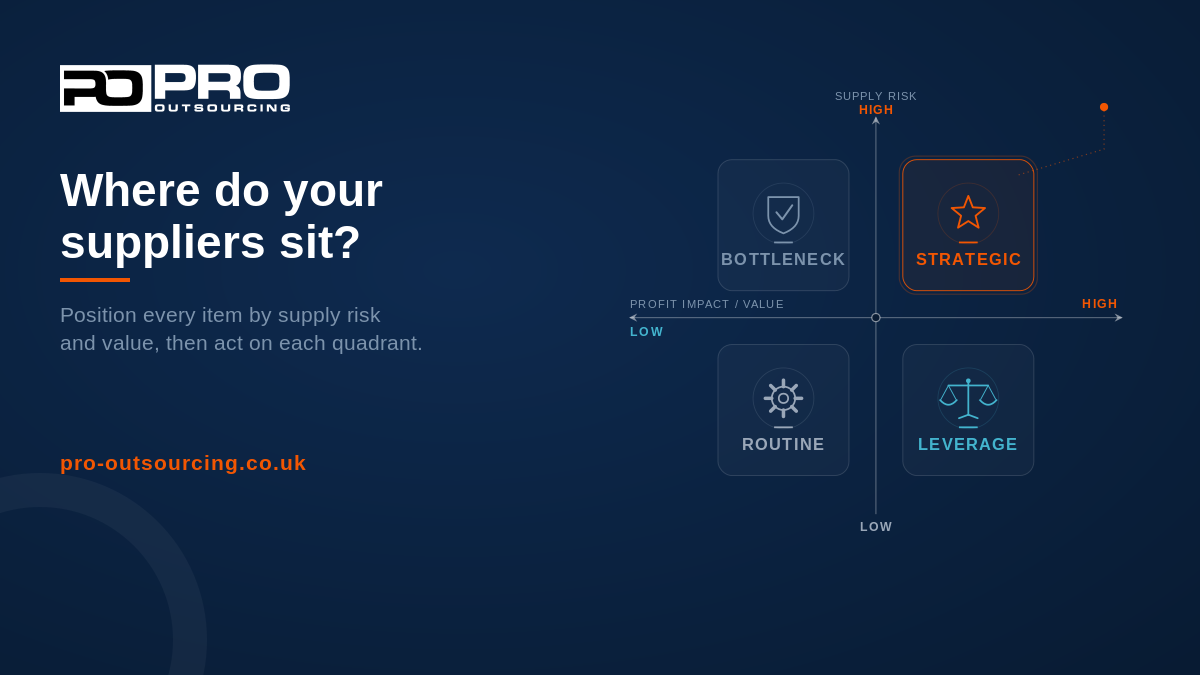
The model positions every item against two questions.
The first is supply risk. How exposed are you if this item is late, short, or unavailable. Few suppliers, long lead times, fragile logistics and hard to switch specifications all push risk up.
The second is profit impact, or value. How much does this item matter to your commercials. High spend, a direct effect on your product or margin, and visibility to the customer all push impact up.
Score both, and every item lands in one of four quadrants. The skill is not in the plotting. It is in what you do next.
How to build it, step by step
This is the operational part that usually gets skipped.
Step one. Get your spend in front of you. Pull a spend analysis or a category list. You do not need perfect data to start. A ranked list of what you buy and roughly what you spend is enough for a first pass.
Step two. Score each item. Use four simple questions, two for each axis. How difficult is this to source. How much risk is there of supply problems. How significant is the spend. What is its impact on profit. Score each one to ten. The two supply questions set the vertical position, the two value questions set the horizontal.
Step three. Plot and read the quadrants. Once items are positioned, patterns appear fast. You will usually find a long tail of routine spend, a cluster of leverage items where money is being left on the table, and a small number of strategic and bottleneck items that carry most of your real risk.
Step four. Set the strategy per quadrant. This is where position becomes plan. Each quadrant needs a different commercial approach, summarised below.
Step five. Turn it into actions with owners and dates. A position on a chart changes nothing on its own. Assign each priority item an owner, a clear action, and a review date. Then put a cadence around it, quarterly is sensible for most, so the picture stays current as markets and demand shift.
What to actually do in each quadrant
| Quadrant | What it means | Commercial focus | Typical actions |
|---|---|---|---|
| Strategic | High risk, high value | Partnership and security | Long term agreements, joint planning, dual sourcing, shared risk and innovation |
| Bottleneck | High risk, low value | Continuity of supply | Buffer or safety stock, alternative sources, risk managed contracts, design out the dependency |
| Leverage | Low risk, high value | Use your buying power | Competitive tension, structured negotiation, volume consolidation, standardised specifications |
| Routine | Low risk, low value | Efficiency | Standardise, automate, reduce supplier count, catalogues and purchasing cards |
The most common quick win sits in the leverage quadrant, where there are plenty of suppliers and enough spend to make competition pay. The most common blind spot sits in bottleneck, where a small, low value item can stop a line because nobody thought it mattered until it ran out.
Where teams get it wrong
A few traps are worth naming. Teams over engineer the routine quadrant, applying full sourcing processes to items that should be automated and forgotten. They under invest in bottleneck items because the spend looks trivial, right up until supply fails. And they treat the exercise as a one off, when its real value comes from revisiting it as the business changes. Position is not permanent. An item can drift from leverage toward strategic as a market consolidates, and you want to see that coming.
Where this fits in a wider strategy
Supplier positioning is not the whole of procurement strategy, but it is the spine. It tells you where to point your governance, your sourcing pipeline and your supplier management effort. Layer your spend data and supplier risk checks on top, and you have a procurement function that allocates its attention deliberately rather than by whoever shouts loudest. That is the difference between a team that processes purchase orders and one that manages a supply base.
Put it into practice
We built a free tool to make the first pass easy. You enter your items, score the four questions, and it positions everything on the matrix and tells you the recommended focus for each one. No sign up needed to try it, and you can print the result or save it as a PDF to brief your team.
Free tool
Where do your suppliers sit?
Score each item across four quick questions. Supply risk, profit impact and the recommended strategy update live as you type, and every item is placed on the matrix for you. No email gate, free to use and share with your team.
Runs in any browser. No sign up. Print or save as a PDF when you are done.
Try the free Supplier Positioning Tool here: https://www.pro-outsourcing.co.uk/procurement-supply-chain-insights/building-a-procurement-strategy/
If you would like a hand turning the output into a working strategy, that is what we do. Pro Outsourcing provides hands on procurement leadership, sourcing and supplier governance to organisations that need senior capability without the full time cost. Book a free procurement review, no obligation and no hard sell, at pro-outsourcing.co.uk.
great resources:
CIPS – Leading global excellence in procurement and supply