
Should You Outsource Procurement? A Decision Test
The wrong question is the one most businesses ask first
Almost every conversation I have with an MD or FD about outsourcing starts the same way. Will it save us money. It is the wrong opening question, because the honest answer is that it depends entirely on what you have today and what you are trying to fix. The right opening question is more basic. Is our current procurement setup actually doing the job, and if not, what shape of fix do we need.
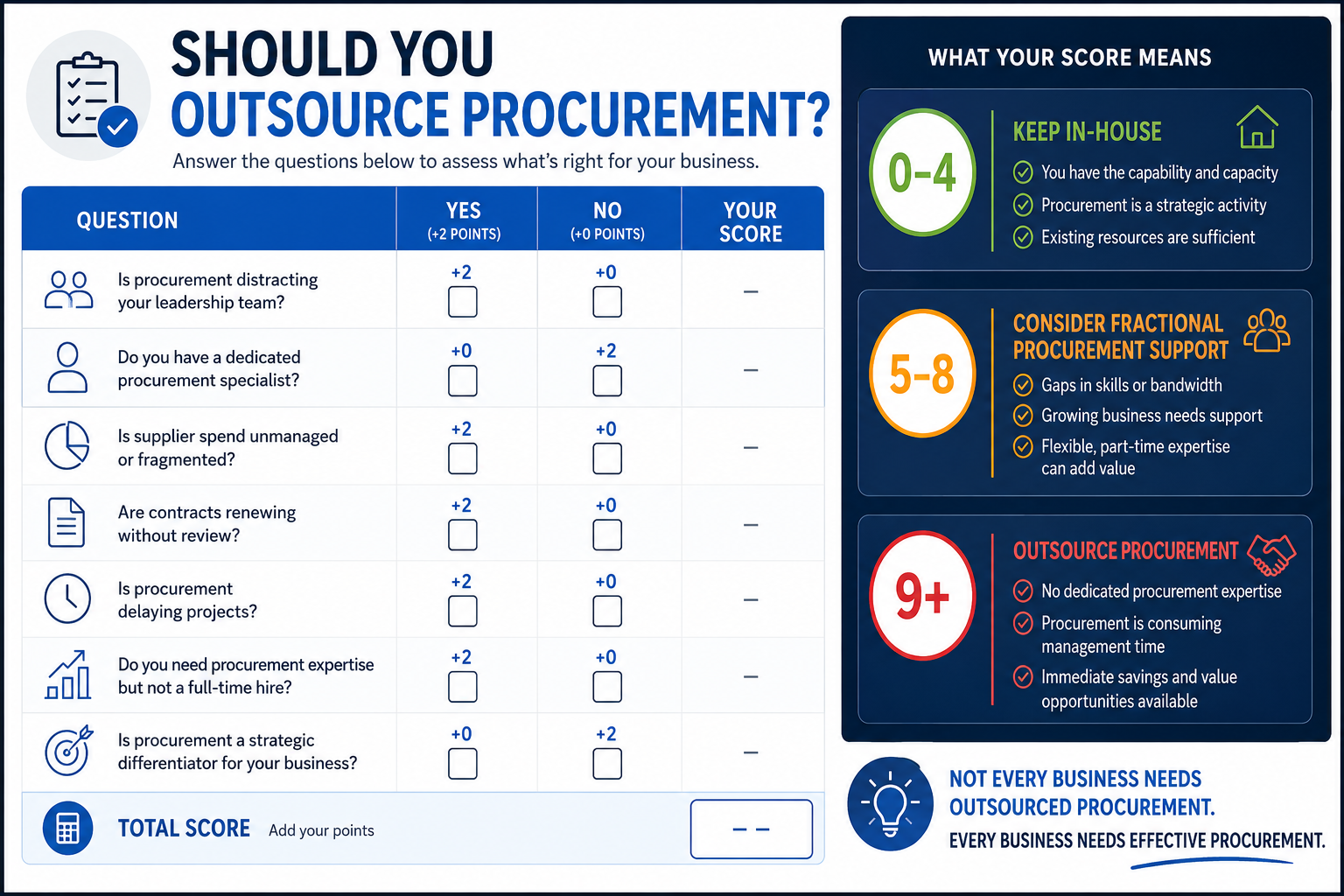
That decision is not a gut call. There are roughly seven variables that determine whether outsourcing is a good fit, a partial fit, or a bad fit. Work through them honestly, score yourself, and the answer falls out. Nothing here is sophisticated. It is just structured.
How to use this
Score each of the seven questions zero, one or two, where zero means the situation does not apply, one means it partially applies, and two means it clearly applies. Add the total at the end. The interpretation bands are at the bottom of the post. Twenty minutes with a coffee is enough.
The seven questions
Question 1, spend level. Does your business spend more than £3m a year with third parties, excluding payroll and tax? Outsourcing rarely pays back below that threshold because the fixed cost of running a function is not justified by the spend base it manages. Score two if you are clearly above, one if you are in the £2m to £3m range, zero if below.
Question 2, current procurement capability. Do you have a named, qualified procurement lead with the time and authority to actually run the function? Not a finance manager picking it up on the side, not an office manager raising POs. Score two if there is no such role at all, one if it exists but is partially loaded with other duties, zero if you have a working team.
Question 3, governance maturity. Is there a central contract register, a signed-off procurement policy, and a clear delegation of authority for spend decisions? Score two if those things either do not exist or have not been touched in two years, one if they exist on paper but are not used, zero if they are live and respected.
Question 4, ERP and data state. Can you produce a clean spend cube by category and supplier in less than a day, without manual rework? Score two if the data is fragmented across systems or spreadsheets, one if it exists but needs heavy cleaning, zero if reporting is reliable.
Question 5, growth trajectory. Is the business growing, acquiring, or integrating, such that supplier volumes and complexity will increase materially over the next twenty four months? Score two if yes clearly, one if probably, zero if the business is stable or contracting.
Question 6, leadership bandwidth. Are the MD and FD currently spending time on supplier issues, contract negotiations or vendor escalations that should not be on their desks? Score two if this is a weekly occurrence, one if monthly, zero if rarely.
Question 7, risk appetite for a hire. Are you willing and able to recruit a senior procurement leader at £80k to £120k all-in, accept the time-to-hire, and absorb the risk if it does not work out? Score two if no, one if reluctantly, zero if yes without hesitation.
The scoring table
If you prefer to work straight from a table, here it is in one place.
| Question | Score 0 | Score 1 | Score 2 |
| 1. Third-party spend over £3m | Under £2m | £2m to £3m | Clearly over £3m |
| 2. Named procurement lead in place | Full team in place | Partial or shared role | No such role |
| 3. Governance, policy and contract register | Live and used | Exists but dormant | Missing or stale |
| 4. Clean spend data on demand | Reliable reporting | Needs heavy cleaning | Fragmented or manual |
| 5. Growth, acquisition or integration ahead | Stable or contracting | Probably | Clearly yes |
| 6. Leadership time spent on supplier issues | Rarely | Monthly | Weekly |
| 7. Appetite for a senior procurement hire | Yes, comfortable | Reluctantly | No |
Interpreting the score
Zero to five, do nothing for now. Your current setup is either adequate or not yet at the spend level where outsourcing makes commercial sense. Tidy what you have, get the contract register up to date, and revisit in twelve months. Procurement outsourcing is not a universal answer and forcing it where it does not fit wastes everyone’s time.
Six to nine, fractional or selective in-house. You have real gaps but not enough scale to justify a full outsourced function. A fractional procurement lead, or a targeted project to fix governance and data first, will usually deliver more value than a full outsourcing arrangement. Some businesses in this band run a hybrid model where transactional work is outsourced and strategy stays internal.
Ten to fourteen, strong outsourcing fit. You have the spend base, you have meaningful capability gaps, and you do not have the appetite or runway to build a team from scratch. A procurement outsourcing partner will typically pay back within the first year on saved spend alone, with the governance and risk benefits on top. At this end of the scale, the cost of delay is usually higher than the cost of getting it slightly wrong.
Two honest caveats
First, no scoring framework substitutes for a proper diagnostic. This test tells you whether the conversation is worth having, not how to design the engagement. The shape of any actual arrangement still needs sizing to your sector, supplier base and operating model.
Second, the worst answer is the comfortable one. Most businesses score themselves more generously on questions two and three than the evidence supports. If you are not sure, ask your auditor or your FD what they think the contract register looks like in practice. The answer is rarely what you would write down yourself.
Take the Scorecard in 60 Seconds
Score yourself across the seven questions, the total updates live and your recommended next step appears at the bottom. No email gate, free to download and share with your team.
Open the Interactive Scorecard
Runs in any browser. No sign up. Print or save as a PDF when you are done.
If you want a second opinion on your score, or a structured walk through your spend profile, get in touch for a 30-minute conversation.
great resources:
CIPS – Leading global excellence in procurement and supply