
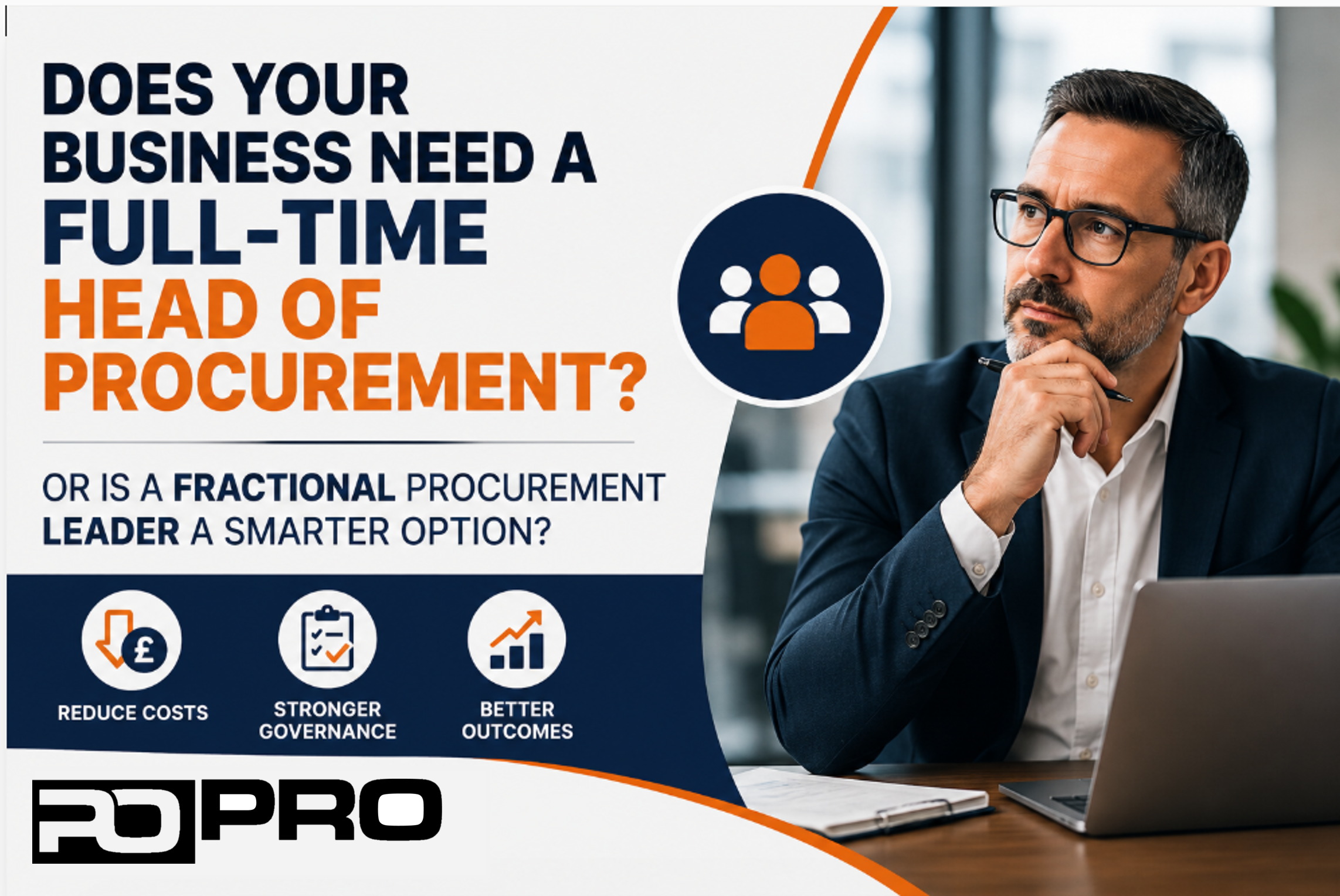
Does Your Business Need a Fractional Procurement Leader or a Full-Time Head of Procurement?
A fractional procurement leader can provide senior procurement expertise, supplier management and governance support without the cost of a full-time executive hire. For many SMEs, choosing between a fractional procurement leader and a permanent Head of Procurement is not as straightforward as it first appears.
At some point, procurement stops being an administrative task and becomes a business risk.
Supplier spend increases. Contracts start renewing without challenge. Key suppliers become harder to manage. Governance gaps emerge. The people responsible for purchasing are often juggling procurement alongside finance, operations or another full-time role.
The instinctive response is usually to recruit.
Advertise for a Head of Procurement. Hire a Procurement Manager. Add headcount and hope the problem goes away.
Sometimes that is absolutely the right answer.
Often it isn’t.
The real question is not whether your business needs procurement leadership. Most growing organisations do.
The question is whether you need that leadership five days a week, or whether you need experienced procurement capability focused on delivering specific outcomes.
What Is Fractional Procurement?
A fractional procurement leader is an experienced procurement executive who works with a business on a part-time basis, typically one or two days per week, providing strategic leadership, supplier management, governance and commercial expertise without the cost of a full-time senior appointment.
The focus is not on filling a seat.
The focus is on delivering outcomes.
That might include:
- Reducing supplier costs
- Improving procurement governance
- Renegotiating contracts
- Building procurement processes
- Supporting an ERP implementation
- Managing strategic sourcing exercises
- Improving supplier performance
- Strengthening commercial controls
For many SMEs, these are the activities that create value, yet they rarely require a full-time executive.
The Hidden Cost of Choosing a Full-Time Procurement Leader
A full-time Head of Procurement in the UK will typically cost between £75,000 and £110,000 per year before benefits, employer National Insurance contributions, pension costs, bonuses and recruitment fees are considered.
By the time all costs are included, many organisations are investing between £100,000 and £130,000 during the first year before a single pound of value has been delivered.
For businesses spending £20 million or more with suppliers, that investment can make complete sense.
For businesses spending £1 million to £10 million annually, the economics are often less convincing.
What frequently happens is that the individual becomes underutilised or absorbed into operational tasks that have little strategic value.
I’ve worked with organisations where a procurement manager was recruited with the best intentions, only to spend most of their time chasing approvals, processing purchase orders and resolving administrative issues.
Meanwhile:
- Contracts continue to auto-renew
- Supplier performance is not measured
- Procurement governance remains weak
- Savings opportunities go unidentified
- Commercial risk remains hidden
That is rarely a people issue.
It is usually a structural issue.
When Fractional Procurement Makes More Sense
Fractional procurement support is particularly effective when a business needs senior expertise but does not yet require a permanent executive role.
Typical indicators include:
| Indicator | What It Usually Means |
|---|---|
| Third-party spend between £1m and £15m | Procurement matters, but may not justify a full-time leader |
| Procurement responsibilities sit with finance or operations | Leadership and structure are missing |
| Contracts renew automatically | Commercial opportunities are being missed |
| Supplier performance is unmanaged | Risk and value leakage are increasing |
| Procurement governance is inconsistent | Controls and visibility need strengthening |
| The board is asking more questions about spend | Procurement maturity needs to improve |
| ERP implementation, acquisition or restructuring activity is planned | Specialist leadership is needed for a defined period |
If several of these apply, a fractional procurement model is often the most commercially sensible solution.
A Real Example
One manufacturing client with approximately £8 million of annual supplier spend engaged procurement leadership support for two days per week.
Within six months the business had:
- Consolidated key suppliers
- Improved contract visibility
- Introduced procurement governance controls
- Renegotiated several major agreements
- Identified savings opportunities that significantly exceeded the cost of the engagement
The business gained experienced procurement leadership without committing to a permanent six-figure hire before the requirement genuinely existed.
When a Permanent Procurement Hire Is the Right Decision
Fractional procurement is not always the answer.
There are clear situations where a permanent procurement leader is the correct choice.
For example:
- Annual supplier spend exceeds £20 million
- A dedicated procurement team already exists
- Strategic procurement activity genuinely fills a full working week
- Procurement leadership is required daily at executive level
- Long-term succession planning is a priority
- The business has reached a scale where a permanent function is fully justified
The mistake many organisations make is assuming a full-time hire should be the default option.
It should be an informed commercial decision based on need, not a reflex response to growing spend.
What Effective Fractional Procurement Support Looks Like
Many people assume fractional support means occasional advice calls and PowerPoint presentations.
It shouldn’t.
Effective fractional procurement support is embedded within the organisation and accountable for delivery.
A successful engagement typically includes:
- One or two days per week of dedicated support
- Direct access to senior leadership
- Ownership of agreed objectives
- Supplier engagement and negotiation activity
- Governance improvements
- Contract management support
- Procurement transformation initiatives
- Clear reporting and measurable outcomes
You gain access to senior expertise, established networks and practical delivery capability without carrying permanent overhead.
The Commercial Benefits of Fractional Procurement
For many SMEs, the choice is not actually between fractional procurement and a permanent procurement leader.
The choice is often between fractional procurement support and doing nothing.
The permanent role is postponed because budgets are tight or priorities change.
Procurement becomes a side responsibility for somebody already carrying a full workload.
Meanwhile:
- Suppliers remain unchallenged
- Costs continue to increase
- Contracts receive little attention
- Governance weaknesses persist
- Opportunities are missed
That is usually the most expensive option of all.
So How Do You Decide?
Three simple questions will usually provide clarity.
1. What is our total supplier spend?
Look beyond the obvious categories and understand the true annual value flowing through your supply chain.
2. What outcomes do we need over the next 12 months?
Examples may include:
- Cost reduction
- Contract coverage
- Supplier consolidation
- Governance improvements
- ERP implementation support
- Procurement transformation
3. Do we need outcomes delivered or simply a role filled?
That distinction is important.
If you need measurable procurement outcomes delivered, a fractional model may be the strongest commercial option.
If you need a permanent leadership position embedded within the organisation long term, a full-time appointment may be the right investment.
Frequently Asked Questions About Fractional Procurement
What is a fractional procurement leader?
A fractional procurement leader provides senior procurement expertise on a part-time basis, helping organisations improve supplier management, governance, commercial performance and procurement capability without the cost of a full-time executive.
How much does fractional procurement support cost?
Costs vary depending on scope and time commitment, but fractional support typically provides access to senior procurement expertise at a significantly lower cost than employing a permanent procurement director or chief procurement officer.
What size business benefits most from fractional procurement?
Businesses with annual supplier spend between £1 million and £15 million often achieve the greatest benefit, particularly where procurement responsibilities currently sit within finance, operations or general management functions.
What is the difference between interim and fractional procurement support?
Interim procurement support usually fills a vacant role on a temporary full-time basis. Fractional procurement support provides part-time senior expertise focused on delivering agreed business outcomes.
Can a fractional procurement leader deliver measurable savings?
Yes. Cost reduction, supplier consolidation, contract optimisation and improved governance frequently generate value that exceeds the cost of engagement.
How many days per week does a fractional procurement leader typically work?
Most engagements range from one to three days per week depending on business requirements, complexity and objectives.
Final Thought
Procurement is one of the few business functions where organisations can access senior leadership capability without committing to senior permanent overhead.
The businesses that benefit most are those that focus on outcomes rather than organisational charts.
Before writing the next procurement job description, it may be worth asking a simpler question:
Do we need a procurement leader full time, or do we simply need procurement leadership?
Fractional Procurement Services – Pro Outsourcing
great resources:
CIPS – Leading global excellence in procurement and supply