
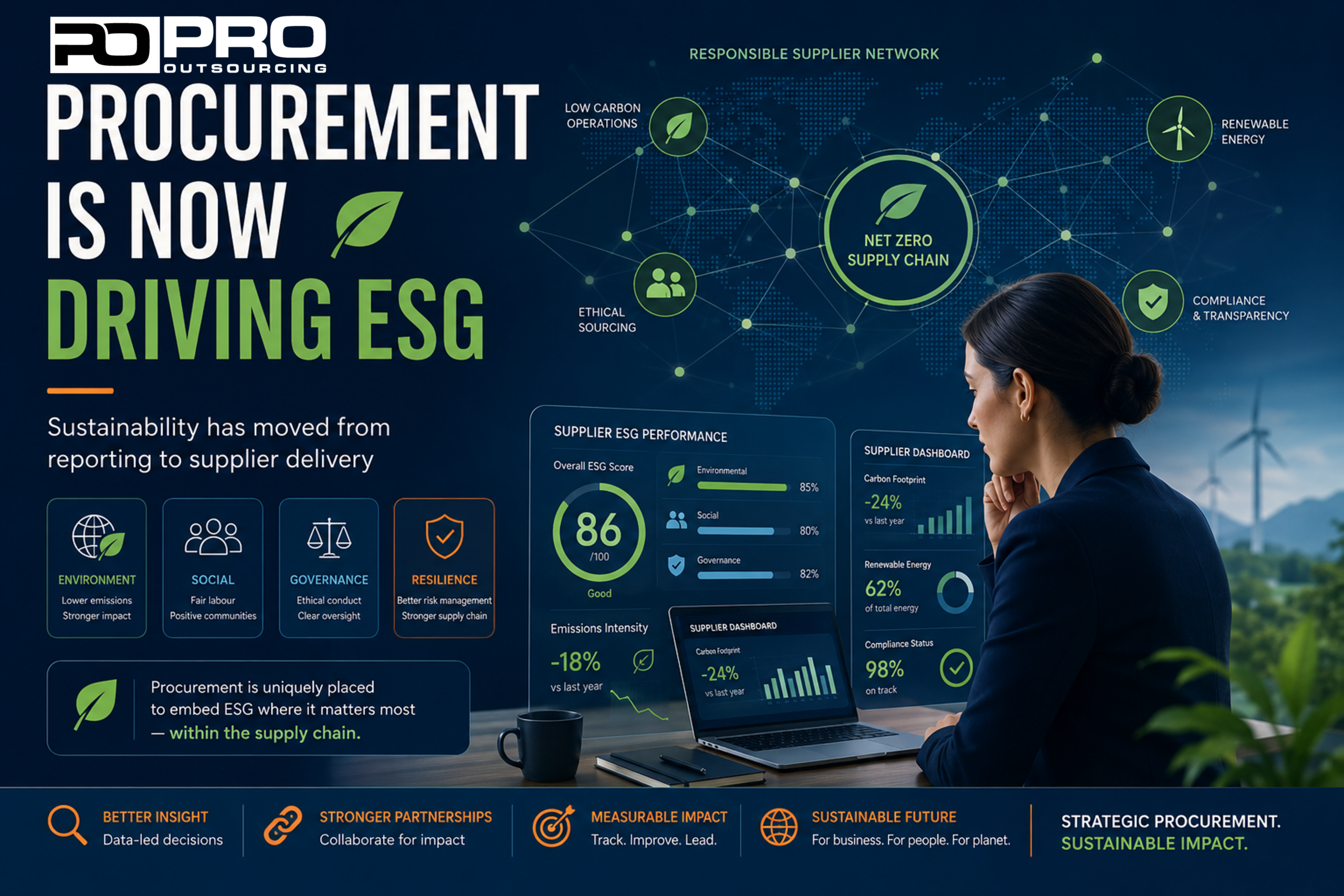
ESG Is No Longer a Side Project, Procurement Is Now Driving It
Procurement and ESG are now far more closely connected than most organisations realise.
The latest CIPS Global State of Procurement & Supply 2026 Report shows procurement is increasingly becoming the function responsible for delivering ESG commitments across supplier networks and operational supply chains.
And honestly, it makes complete sense.
Because ESG ultimately lives inside supply chains.
Procurement Is Becoming the Delivery Engine for ESG
According to the report:
- 93% of organisations say ESG importance is growing or remaining stable
- The number of organisations where procurement owns ESG delivery has doubled from 10% to 21%
- 59% include ESG clauses in supplier contracts
- 57% use ESG criteria in supplier selection decisions
- 41% already have net-zero or science-based targets that include Scope 3 supply chain emissions
This is the important bit.
ESG is moving away from corporate messaging and into operational delivery.
And procurement sits directly in the middle of supplier behaviour, sourcing decisions, contract management, and supply chain governance.
Which means procurement becomes the natural owner.
ESG Without Procurement Was Always Going to Struggle
You cannot improve supplier sustainability without engaging suppliers.
You cannot reduce Scope 3 emissions without understanding your supply chain.
You cannot improve ethical sourcing without procurement controls.
And you definitely cannot build resilient supplier ecosystems without commercial visibility.
This is why the report repeatedly links procurement with resilience, risk, sustainability, and long-term business value.
Modern procurement is increasingly responsible for balancing:
- cost
- risk
- resilience
- governance
- sustainability
- operational continuity
All at the same time.
No pressure then!
Procurement Is Redefining “Value”
One of the strongest insights in the report is that organisations are beginning to rethink what value actually means.
Historically, procurement value often meant lowest cost.
Now, businesses are increasingly looking at:
- total cost of ownership
- supplier resilience
- climate risk
- continuity of supply
- ethical sourcing
- governance standards
- long-term operational stability
That changes procurement conversations dramatically.
The cheapest supplier is not always the lowest risk supplier.
The fastest supplier is not always the most sustainable supplier.
The lowest upfront cost can easily become the highest long-term operational cost.
Good procurement teams already know this.
Now leadership teams are catching up.
Procurement’s ESG Role Will Continue to Grow
The report describes procurement as becoming “one of the most important sustainability leaders in the organisation”.
That is a major statement.
Especially considering procurement was often excluded from ESG discussions entirely a few years ago.
The organisations seeing the biggest progress are the ones embedding ESG directly into sourcing, contracts, supplier onboarding, and supplier management processes.
Not treating it as a separate initiative.
That is where procurement creates real commercial value.
Because sustainable supply chains are usually more resilient supply chains too.
See our other blogs
Recommended further reading: