
Procurement KPIs and Dashboards: Top Metrics + Examples
Procurement KPIs and dashboards help you measure savings, supplier performance, cycle time, compliance, and risk, so leadership can clearly see procurement’s impact. In this guide to procurement KPIs and dashboards, you’ll learn the most useful metrics to track and how to structure a dashboard that supports smarter decisions.
Internal link: Learn more about our approach to procurement transformation: Procurement Consultancy Services
Outbound credibility link: For procurement standards and best practice, see CIPS resources: https://www.cips.org/ (example)Procurement KPIs and Dashboards: What to Measure and Why
The best procurement KPIs and dashboards focus on outcomes: value delivered, service levels, compliance, and risk. Tracking too many metrics creates noise tracking the right ones creates clarity.
A practical KPI set should answer:
- Are we delivering measurable savings and value?
- Are suppliers performing consistently?
- Are we buying faster and with fewer issues?
- Are stakeholders compliant with contracts and policy?
- Where are we exposed to supply chain risk?
Internal link: If you’re building a category strategy alongside KPIs, see: Category Management Support
Procurement KPI 1: Cost Savings (Cost Reduction vs Cost Avoidance)
Cost savings show the value procurement brings to the business. Track this in a consistent way and align the method with Finance.
What to measure
- Cost reduction: lowering an existing cost (e.g., negotiated price decrease)
- Cost avoidance: preventing a forecasted increase (e.g., holding pricing flat against market increases)
- Savings realised vs negotiated: what actually hit the P&L
Dashboard tip: show savings by category, business unit, and initiative owner, plus a monthly trend.
Procurement KPI 2: Supplier Performance (Delivery, Quality, Compliance)
Supplier performance is a leading indicator of service reliability and operational continuity.
What to measure
- On-time delivery (OTD)
- Quality/defect rate
- Lead-time adherence
- Responsiveness and issue resolution time
- Contract compliance on supplier side (SLAs, reporting, certifications)
Dashboard tip: create a supplier scorecard view for top suppliers by spend and criticality.
Outbound link example (supplier performance thinking): ISM (Institute for Supply Management) resources: https://www.ismworld.org/ (example)
Procurement KPI 3: Procurement Cycle Time (Request to Receipt)
Procurement cycle time measures how long it takes to complete the process—from identifying the need to receiving the goods or services.
What to measure
- Requisition raised → approval time
- Sourcing/quote time (if applicable)
- PO creation time
- Supplier fulfilment time
- Goods receipt and invoice match time
Dashboard tip: show the “end-to-end” time and split it into stages so you can pinpoint bottlenecks.
Procurement KPI 4: Purchase Order Cycle Time (PO to Fulfilment)
Purchase order cycle time focuses specifically on how quickly suppliers fulfil POs after they’re issued.
What to measure
- PO issued → confirmed
- Confirmed → shipped / delivered
- Delivered → receipted
Dashboard tip: compare PO cycle time by supplier and category to identify underperformance or unrealistic lead times.
Procurement KPI 5: Contract Compliance (Policy and Preferred Supplier Use)
Contract compliance shows whether stakeholders are buying through approved routes (preferred suppliers, correct terms, and negotiated pricing).
What to measure
- % spend on contract vs off-contract
- Maverick spend by category/department
- Price variance vs contracted price
- Exceptions raised and resolved
Dashboard tip: present compliance as a simple gauge (e.g., 85% on-contract) plus a list of top off-contract categories.
Internal link: Learn how we reduce maverick spend with process design: Procurement Process Improvement
Procurement KPI 6: Spend Under Management (Coverage and Control)
Spend under management measures how much total organisational spend is actively governed by procurement policies, contracts, and supplier management.
What to measure
- % of total spend under procurement governance
- % of spend with preferred suppliers
- % of spend with negotiated contracts
Dashboard tip: include a coverage trend line and a “top unmanaged spend categories” table to guide priorities.
Procurement KPI 7: Supplier Concentration (Dependency and Risk)
Supplier concentration highlights dependency on a small number of suppliers, which increases operational and continuity risk.
What to measure
- % of spend with top 1, top 5, top 10 suppliers
- Concentration within critical categories
- Single-source vs multi-source split
- Geographic concentration (where relevant)
Dashboard tip: add a simple risk flag for categories where a single supplier accounts for a high share of spend.
Internal link: For supply risk support, see: Supply Chain Risk & Resilience
Procurement KPI 8: Savings Sustainability (Long-Term Value Realisation)
Negotiated savings are only valuable if they’re maintained.
What to measure
- % of negotiated savings realised across contract life
- Price creep or rate drift over time
- Leakage drivers (off-contract buying, poor controls, spec changes)
Dashboard tip: add a “savings sustainability” view that compares baseline vs actual costs over time.
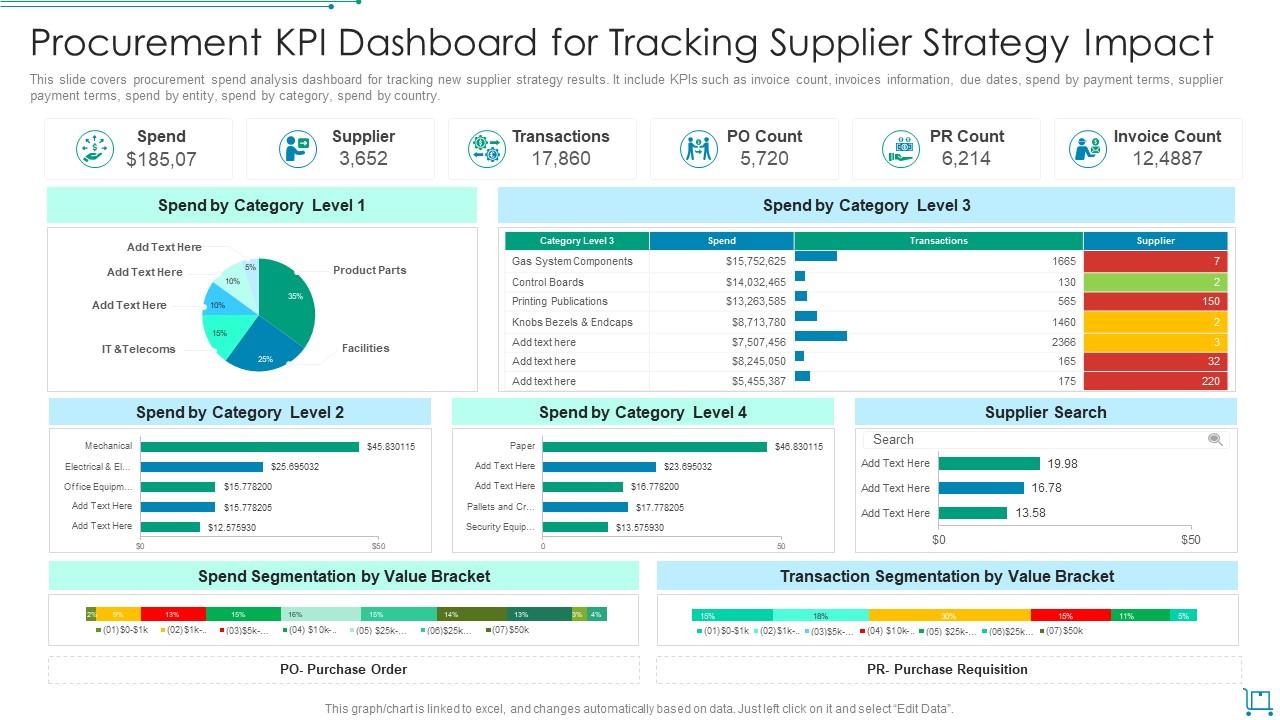
What to Include in a Procurement Dashboard (Examples)
A strong procurement KPIs and dashboards setup should be easy to understand in minutes. Use a layered approach: executive summary first, then drill-down.
Executive summary tiles (top row)
- Total spend (month/quarter/YTD)
- Savings realised (YTD)
- On-contract spend %
- Procurement cycle time (avg + trend)
- Supplier performance (OTD %, quality)
- Risk flags (concentration, critical supplier issues)
Trend charts (visibility over time)
- Savings realised over time (monthly)
- Cycle time trend by stage (approval, sourcing, PO, fulfilment)
- Supplier performance trends (OTD + defects)
Supplier scorecards (actionable views)
- Top suppliers by spend with OTD, quality, issue rate
- Corrective actions and owners
- SLA compliance (for services)
Compliance and control
- Off-contract spend by department/category
- Price variance exceptions
- Contract coverage status
Risk heatmap (simple, practical)
- Category risk score (supply market + internal dependency)
- Critical supplier status and contingency notes
Common KPI Mistakes to Avoid
- Tracking too many KPIs and not acting on any
- Measuring negotiated savings but not realised savings
- Not aligning definitions with Finance (especially cost avoidance)
- Ignoring cycle-time stages (you can’t fix what you can’t locate)
- Building dashboards that look good but don’t support decisions
Summary: Make Procurement Performance Visible
The most effective procurement KPIs and dashboards connect day-to-day work to business outcomes, value, service, speed, compliance, and risk. Start with a clear KPI set, define each metric consistently, and build a dashboard that helps leaders make decisions quickly.
Pro Outsourcing, operating throughout Europe from our base in Wrexham, North Wales, provides procurement and supply chain consultancy services across all market sectors. If you want help selecting the right procurement KPIs and dashboards, building the reporting structure, or improving performance end-to-end, explore our services or contact us.
Internal links: About Pro Outsourcing | Contact Us | Procurement & Supply Chain Services